Art Therapy for Adults

Located in Lee's Summit, serving adults across the Kansas City area.
Some things are hard to put into words. You start to describe them and the words don't quite fit, or you find yourself telling the same story again and nothing changes.
Art therapy offers another way in. It doesn't replace talking. It gives us a way to reach the parts that are hard to get to through language alone.
I'm a Registered Art Therapist in Lee's Summit with a master's degree in counseling psychology and art therapy. As a Licensed Professional Counselor in Missouri and a Licensed Clinical Professional Counselor in Kansas, I see clients on both sides of the state line.
You Don't Have to Be Good At Art
The reason most people who would benefit from art therapy never try it is because they don't believe they're artistic. Art therapy is not about the quality, it's about the process.
You don't need any artistic ability. Nothing is judged, graded, critiqued or shown to anyone. If the last thing you made was in a school art room and you hated it, that's okay because art therapy isn't art class.
It also isn't coloring to relax. Adult coloring books are a nice way to settle your nervous system and while they are a great coping skill, they're not art therapy. Art therapy uses the creation and artmaking as the route into clinical work — what came up while you were doing it, what you avoided, what surprised you, the relationship between objects on the artwork, what it represents about you.
The aesthetic of what ends up on the paper matters much less than what happens while it's being made and in the reflection afterward.
Distressing experiences and past traumas are often stored as images, sensations and fragments rather than narrative. That's precisely why they resist being talked about — you're trying to convert something that was never verbal into language.
Art skips that conversion. It lets the material come out through the process of creating and by accessing the forms in which it is stored. We use both sides of our brain to access parts of the distress that cannot be accessed by language alone.
Two other things happen. The first is distance: once something is on the paper it is outside you and can be seen as something that is looked at and easier to control than endured. The second is that it eliminates having to find just the right words to describe a feeling. It creates an opportunity for freedom to explore and also make mistakes. People who are very skilled at explaining themselves often find that art therapy creates space for making connections that words alone can't adequately capture. Art therapy allows us to explore things without expectation and it gives us the freedom to not have to know where we're going before we get there.


What Art Therapy Helps With
Trauma, including experiences that words can't adequately capture
Anxiety, including the kind that talking about only seems to feed
Grief, including pregnancy and infant loss, and the sadness and loss that comes with infertility
Depression, and the numbness where feeling used to be
OCD and intrusive thoughts
Identity and the loss of self in the wake of large transitions — after trauma, after becoming a parent, after loss
Feeling stuck in talk therapy, or "I've told this story so many times and nothing changes"
Art Therapy in the Perinatal Years
This is a large part of my practice, and there's a reason the two fit together.
Pregnancy, loss and new parenthood are full of experiences people have no script for. The grief of a loss others may not see. A body that no longer feels like yours. Intrusive thoughts too frightening to say out loud, which can sometimes be drawn before they can be spoken.
Matrescence — the identity shift into motherhood — is another place where images reach further than description. "I don't know who I am any more" is hard to adequately express through simply talking. Art therapy helps us really represent the enormity of the shift that has happened.
More on Postpartum therapy and Miscarriage therapy.
Art Therapy and EMDR Together
I'm both a Registered Art Therapist and EMDR trained, which is an unusual pairing and a useful one.
Art gives us a way to work with material that hasn't yet reached words, somewhere to put what comes up between processing sets, and a visible record of change over time — which matters, because people often can't feel their own progress while it's happening. Art therapy does something that EMDR does well, which is utilizing bilateral stimulation of the brain, which basically means we're using both sides of our brain to process. Often what has happened to us and our verbal processes are not stored in the same areas and both art and EMDR allow us to access things that words alone cannot.
More in the EMDR therapy page.
What a Session Actually Looks Like
Not a class, and not a craft table.
We talk first, the way any therapy session starts. At some point I may suggest working with materials on what we're discussing — sometimes a specific direction, sometimes something open. The materials themselves matter: paint evokes a different energy than pencil does.
Then we look at what you made together. I don't tell you what it means. Art therapy is not interpretation performed at you — you're the one who knows, and my job is asking the questions that get you there.
Sessions are 50 minutes. Some clients work with materials every session, others only when talking runs out. You can always say no, and plenty of people take several sessions before they want to try it at all.
I work with adults of all genders, sexualities, races and identities.
All are welcome here.
Why It Works When Talking Doesn't

Session length, fee and format
Art therapy: 50 minutes · $150
Individual therapy: 50 minutes · $140 · first session $165
Format: in person in Lee's Summit, with materials provided, or virtually anywhere in Missouri or Kansas using your own materials
Payment: HSA, FSA, most major credit cards, debit cards, cash and check
Reduced fee: therapy scholarships are available — please ask
Training in Art Therapy
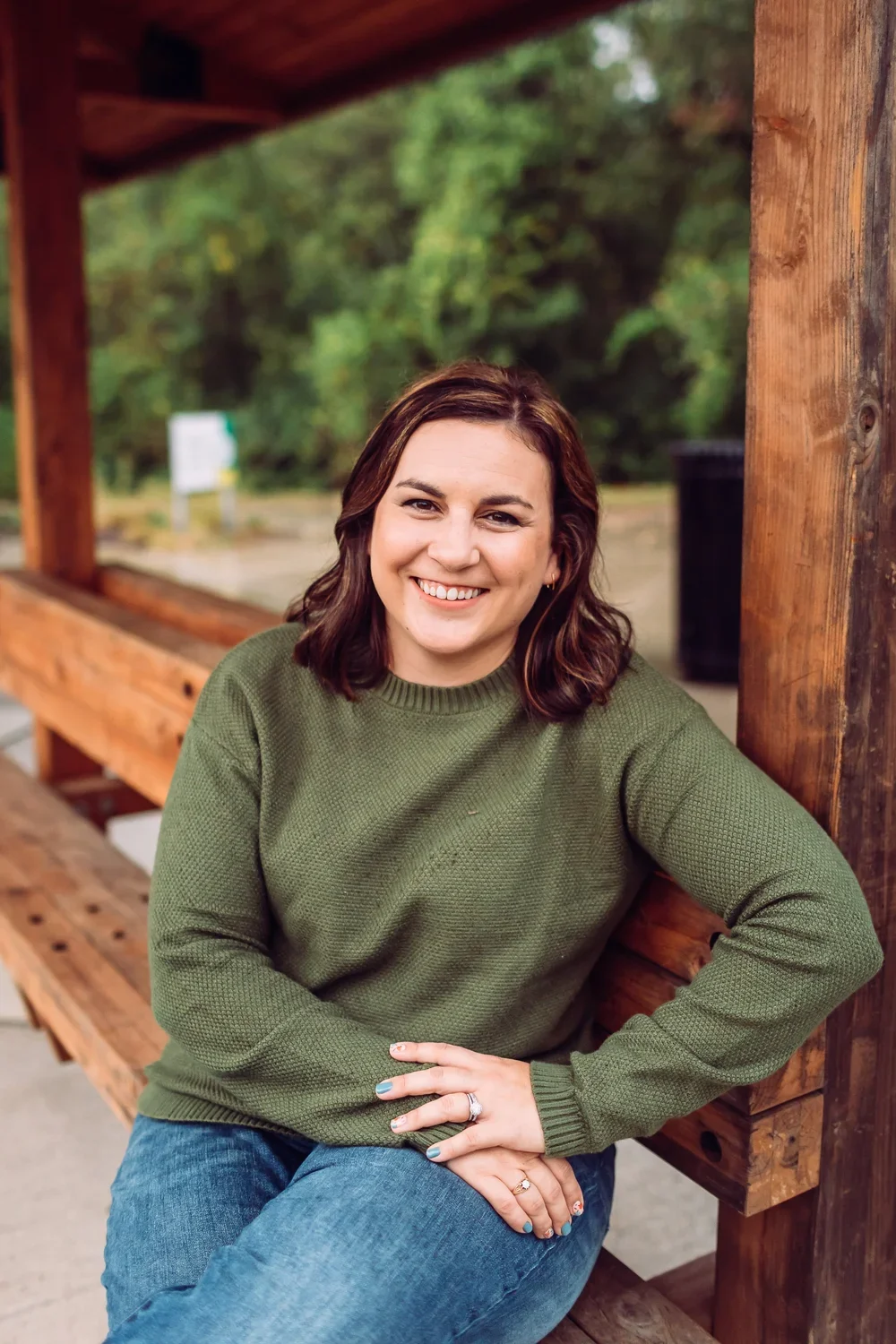
Katie Kirkenmeier, MA, LPC, LCPC, ATR, PMH-C
Registered Art Therapist (ATR)
Master of Arts in Counseling Psychology: Art Therapy, The Adler School of Professional Psychology
EMDR Level 1 and 2 trained
Level 1 and 2 trained in Internal Family Systems through the IFS Institute
Certified in Perinatal Mental Health (PMH-C)
Seven years working exclusively with survivors of sexual violence
Licensed Professional Counselor in Missouri and Licensed Clinical Professional Counselor in Kansas
Questions About Art Therapy
-
Yes. Artistic ability is irrelevant here and nothing you make is graded or critiqued. This is the most common question I get, and it has never once been a factor in art therapy being successful.
-
No. It stays between us, and you decide whether it stays with you or with your file.
-
No. It's often presented that way, which is why adults assume it isn't for them. My practice is adults only, and I work with adults across the full range of what brings people to therapy.
-
I'm out of network. I can provide a superbill you submit for possible out-of-network reimbursement, and HSA and FSA funds are commonly used. More on the superbill page.
-
Yes. I offer art therapy virtually anywhere in Missouri or Kansas. Materials aren't provided for virtual sessions, so you'll use your own. In person in Lee's Summit, the materials are provided.
-
Then we try something else instead. Nothing here is compulsory, and disliking the materials is useful information rather than feeling like you're being forced to do something during your session.
Schedule Art Therapy in Lee's Summit
Book a free 15-minute consultation, send me a message or text 816-875-0078.
I reply within two business days.
If you've run out of ways to say it, this is another way in.